01 / The challenge
How I Built This.
The idea for Rabsatt Design began with a question at AWS Community Day in Miami, not with a hosting service.
“Outside of LinkedIn and GitHub, how are people seeing your work?” — LaMech, AWS Community Day speaker
At first, the answer seemed obvious: LinkedIn and GitHub. But the question made me think more carefully about where people could discover what genuinely interests me, see how I approach technical problems, and explore the solutions I build.
I purchased the Rabsatt Design domain with that goal in mind, but the website remained an idea. I initially considered a managed website builder such as Squarespace. Looking into the pricing prompted a different question: How could I architect this myself?
That changed the project from a personal branding exercise into a real architecture challenge. I needed a secure, fast, cost-conscious site that would be straightforward to operate, leave room for new case studies, and avoid maintaining an unnecessary application server.
I also wanted infrastructure and deployment changes to be reproducible and reviewable. The result is a static portfolio built around private storage, CDN delivery, Terraform, and GitHub Actions an opportunity to demonstrate the same design discipline the site is meant to showcase.
02 / Architecture
One controlled path from domain to object.
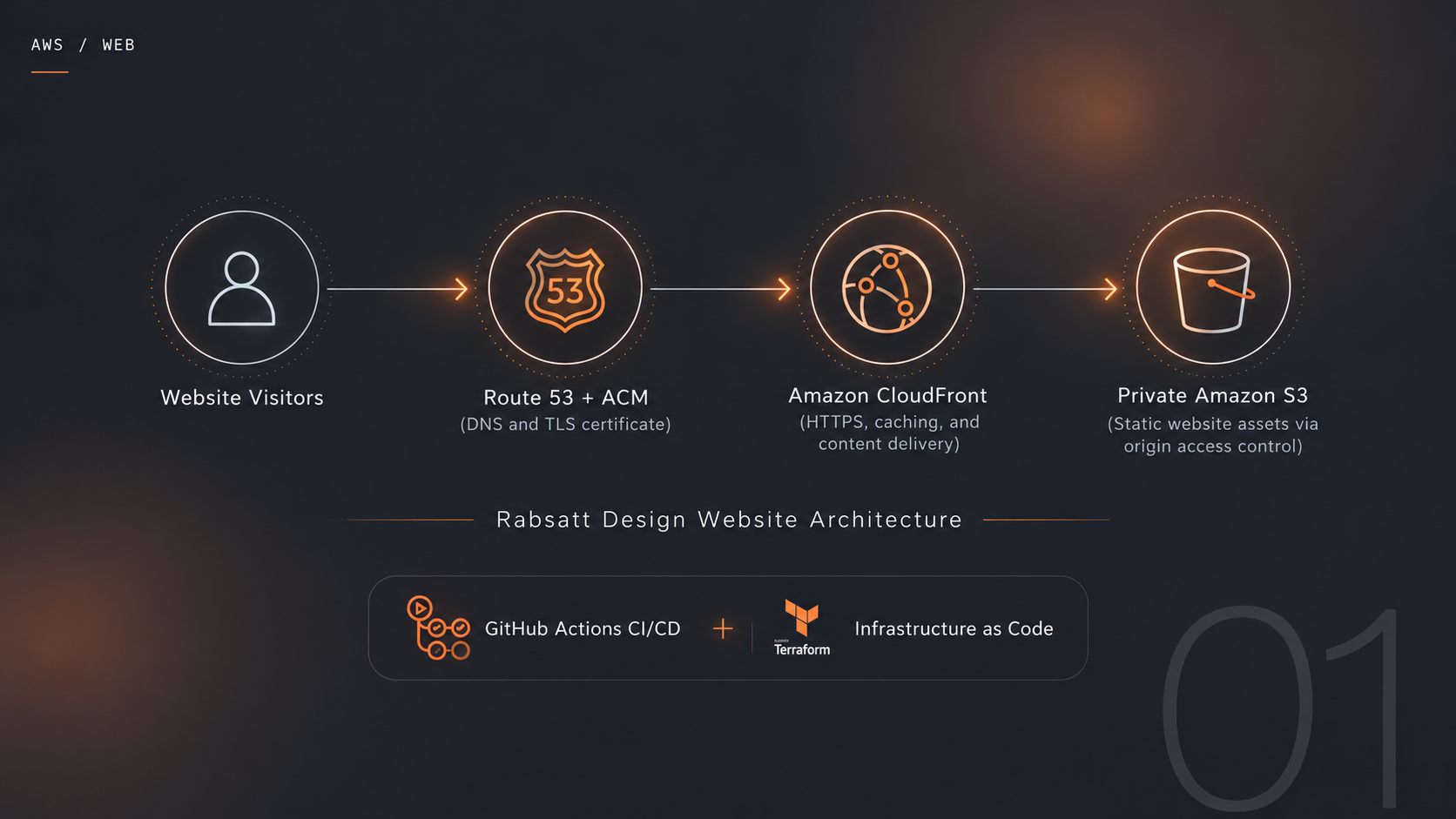
The website serves static content, so I chose managed storage and edge delivery rather than running a web server. Route 53 publishes alias records for the apex and www names. ACM validates the domain and supplies the TLS certificate used by CloudFront; it is not a separate request-processing hop.
CloudFront redirects HTTP traffic to HTTPS, compresses responses, and caches static objects close to visitors. Its origin is the S3 regional endpoint: origin access control signs CloudFront requests so the bucket can remain private while the site is publicly accessible through the distribution.
Resolve the domain
Route 53 aliases direct IPv4 and IPv6 visitors to the CloudFront distribution.
Protect the connection
An ACM certificate in the required CloudFront certificate region enables HTTPS for the public domain.
Deliver at the edge
CloudFront manages caching, compression, and content delivery for the static frontend.
Keep the origin private
S3 stores site assets; CloudFront origin access control governs how they are retrieved.
03 / Architecture decisions
Choose only what the problem needs.
The goal was not to use the most AWS services. It was to meet the site's requirements with a small, understandable architecture.
Static over server-based
A static site avoids application-server maintenance. The tradeoff is that future dynamic functionality would require additional services.
Private S3 through CloudFront
Origin access control avoids exposing a public S3 website origin. It adds CDN and cache configuration that must be maintained.
Terraform over manual setup
Infrastructure as code makes changes repeatable and reviewable. It also requires disciplined state management and infrastructure code maintenance.
Automated over manual deployment
GitHub Actions provides a consistent delivery path. Workflow permissions and approvals become part of the system's operational responsibilities.
04 / Security
Access is narrow by design.
Amazon S3 Block Public Access is enabled for the website bucket. Its bucket policy grants object reads to the CloudFront service principal and conditions that permission on the specific distribution ARN. Visitors therefore request content from CloudFront rather than from S3.
The viewer protocol policy redirects HTTP to HTTPS. DNS validation lets ACM manage certificate renewal, while the domain records remain declared alongside the rest of the infrastructure.
The public surface is the CDN and its custom domain. The storage layer stays behind that boundary.
05 / Delivery
Changes follow a reviewable path.
Terraform holds the infrastructure definition and uses an S3 backend for remote state. Pull requests run the planning workflow, giving reviewers a concrete view of proposed infrastructure changes before an apply.
The apply workflow uses GitHub Actions with AWS role credentials instead of keeping long-lived access keys in the repository. The frontend remains a set of static files, so deployment stays small and predictable.
Delivery sequence
- Update the frontend or Terraform configuration in version control.
- Review the Terraform plan produced for the proposed change.
- Apply approved infrastructure changes through the protected workflow.
- Publish the static assets and let CloudFront serve the current version.
06 / Outcome
More than a website. A foundation for what's next.
Rabsatt Design is now a live AWS-hosted portfolio supported by private object storage, managed HTTPS delivery, and infrastructure defined through Terraform. GitHub Actions provides a repeatable workflow for publishing changes.
The platform can evolve as I add architecture case studies and technical writing, without introducing server maintenance for static pages. More importantly, the project reinforced a principle I want reflected throughout my portfolio: effective Solutions Architecture is about choosing the right level of complexity for the problem.
What started with a question about professional visibility became a working example of secure cloud delivery, infrastructure automation, and deliberate architectural tradeoffs.